
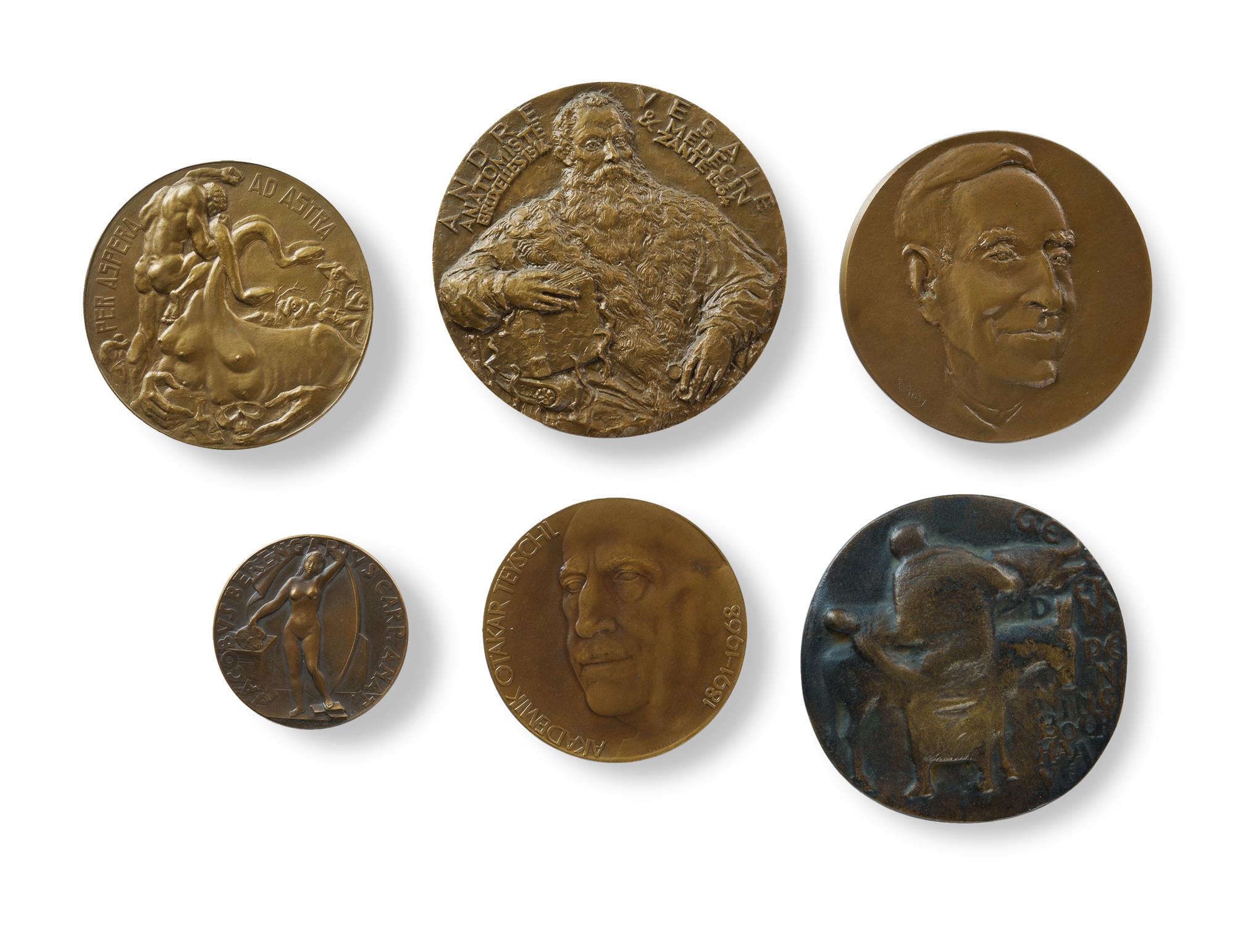

6 Bronze Portrait Medallions
Includes Andreas Vesalius (1514-1564), anatomist, physician, and author of one of the most influential books on human anatomy, De Humani Corporis Fabrica Libri Septem (On the Workings of the Human Body in Seven Volumes). Vesalius is often referred to as the founder of modern human anatomy, designed by Magdeleine Mocquot (1910-1991) (Dia.80mm)
Herman Boerhaave (1668-1738), Dutch botanist, humanist and physician. Regarded as the founder of clinical teaching and of the modern academic hospital, designed by Eric Claus (Dia.75mm)
Paul Ehrlich (1854-1915), German scientist who won the 1908 Nobel Prize in Physiology or Medicine. He is noted for his work in hematology, immunology, and chemotherapy. Ehrlich predicted autoimmunity calling it "horror autotoxicus". He coined the term "chemotherapy" and popularized the concept of a "magic bullet". He is credited with the first empirical observation of the blood-brain barrier and the development of the first antibacterial drug in modern medicine (Dia.65mm)
Otakar Teyschl (1891-1968), physician and pioneer of children's medicine. Head of the Department of children's diseases in today's Teaching Hospital in St. Anny v Brne (Dia.60mm)
Jacobus Berengarius Carpensis (1460-1530), Italian physician, his book "Anatomia Carpi" pub. in 1535 made him the most important anatomist before Andreas Vesalius. (Dia.44mm)
Robert Debré (1882-1978), French physician /paediatrician, designed by Raymond Joly (Dia.71mm)
PROVENANCE:
Collection Late Kenneth F. Russell (1911-1987), Professor of Anatomy and Medical History, University of Melbourne.
Estimate $100-200