
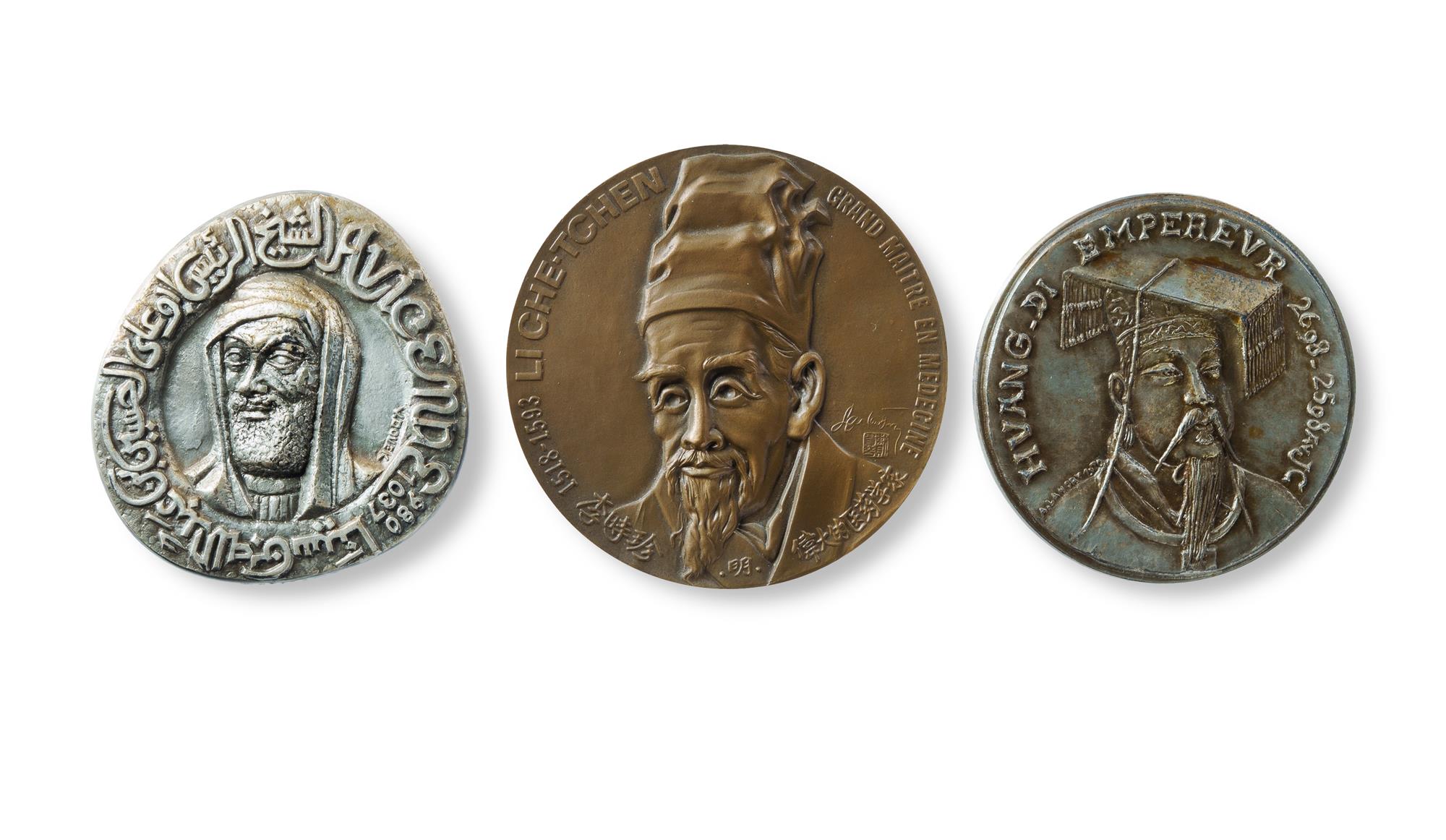
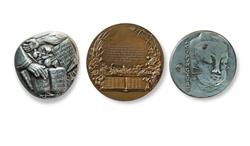

3 Bronze Commemorative Medallions
Includes a silvered bronze portrait medallion of Ibn Sina Avicenne (980-1037), Persian polymath and the foremost [7] physician and philosopher of his time. He was also an astronomer, chemist, geologist, logician, palaeontologist, mathematician, physicist, poet, psychologist, scientist, soldier, statesman, and teacher, designed by Victor Douek, 1973 (H71mm) Edition 15/100.
Silvered bronze portrait medallion of Chinese Emperor Huang Di. He emerged as a chief deity of Taoism during the Han Dynasty (202 BC-220 AD). The legend of his victory in the war against Emperor Chi You at the Battle of Zhuolu is seen as the establishment of the Han Chinese nationality. Among his many accomplishments, Huangdi has been credited with the invention of the principles of Traditional Chinese medicine. The Huangdi Neijing (Inner Canon of Huangdi) was supposedly composed in collaboration with his physician Qibo. His interest in natural health and preventing and treating diseases, according to historical sources, meant he lived to the age of 100, and attained immortality after his physical death, designed by A. Laundry, 1975 (Dia.71mm) Edition 19/100.
Bronze portrait medallion of Li Che-Tchen (Li Shizhen 1518-1593), a Chinese acupuncturist, herbalist, naturalist, pharmacologist, physician, and writer of the Ming dynasty. He is the author of a 27-year work, the Compendium of Materia, Medica. He developed several methods for classifying herb components and medications for treating diseases, designed by Lai Kui Fang (1936-2022), 1974 (Dia.80mm)
PROVENANCE:
Collection Late Kenneth F. Russell (1911-1987), Professor of Anatomy and Medical History, University of Melbourne.
Estimate $80-150